Archive for August, 2006
 Reusing reuse…
Wow, someone stirred the pot today. Miko Matsumura lashed out on the topic of reuse within SOA, along with David Chappell (the .NET David, not the Sonic David), as quoted in Joe McKendrick’s ZDNet SOA blog. This started with another post by Joe, quoting Charles Stack of Flashline BEA. Stephen Anthony commented on his blog with more questions than answers.
One of the biggest mistakes I think could be made would be to sell SOA purely as a way to achieve the IT Holy Grail of reuse. In other words, reusing reuse to sell the latest technology trend in the same way we used it to sell previous technology trends. Should services be used by more than one consumer? Absolutely. Will all of them? Certainly not. In many cases, the service boundary may be the point that separates things that may change from things that don’t (e.g. interface and implementation). In such a scenario, we are likely providing a more agile solution. Rather than having to rip apart the entire solution, only the services impacted by the business change need to be touched. The change may not be within the service, but rather on the consumer side. I may adjust my process definition and invoke the service at a different time. Do these solutions mandate reuse? Certainly not. Agility in supporting the business and its changes are the primary concern. Eliminating redundancy and leveraging exists assets will always be a goal of IT. While that may cut costs, it’s not going to help revenue. Only my meeting the changing needs of the business through agile solutions can that revenue stream be impacted for the better. If you’re cutting your costs at the same time, even better.
One added note. Mark Griffin made a great point in his blog that if you are striving for reuse, you’d better be prepared for handling change management. Sooner or later, that service will be modified and its interface will change. Whether you have one consumer or many, you’ll need to effectively manage that change.
Fund raising…
Another detour from the usual SOA routine for a plug for my eldest daughter’s school, Immaculate Conception. Like many schools, hers is selling Entertainment Books to raise funds. If you don’t know what an Entertainment Book is, it’s a big book of coupons for local restaurants and attractions. Usually, if you keep the book in your car and remember to check for a coupon, you’ll quickly recoup the cost.
Anyway, Their goal for this year is to sell 1500 books, which would net about $16,500 for the school. While I am going to take her around the neighborhood so she can do more of the selling, I’m also doing my part. After all, entertainment.com has set it up so that purchases made through their web site can be credited to individual sellers. That’s a step in the right direction, and if they’re going to make it available, I’ll take advantage of it. To purchase a book for your area, follow this link. Enter your billing and shipping info, and I, my daughter Elena, and Immaculate Conception School, thank you. For those of you that were looking for something SOA related, thanks for you patience! Perhaps entertainment.com can adopt SOA and allow fund raisers to better integrate their efforts!
MetroTix needs an SOA (among other things)
As a subscriber to the broadway series at the Fabulous Fox here in St. Louis, I occasionally get email about upcoming concerts and shows with the ability to buy tickets before the general public, or at least before the portion of the general public that doesn’t know someone who has broadway series tickets. Last night, we came home from a meet the teacher night at my daughter’s school and in my inbox was a message that the Cheetah Girls and Hannah Montana had added another show and we could pre-buy tickets tomorrow. Well, my oldest daughter is only in first grade, but my niece is in third grade, and lives and breathes those shows on the Disney Channel. So, my wife was tasked with the responsibility of getting tickets the next morning.
This morning, 15 minutes after tickets went on sale, my wife called me with her frustrations in trying to obtain tickets. There seemed to be no rhyme or reason to what tickets showed up as “best available.” When I decided to help out, the site went haywire and would only return me unreadable characters. While we think we managed to purchase some tickets (we still haven’t received any email confirmations 10 hours later), the experience was about as bad as it can get. Of course, MetroTix has a virtual monopoly on ticket sales so they can get away with having awful service, because there’s nowhere else to go.
Anyway, my point was not to complain about the awful service. What I wanted to discuss was their need for SOA. For all I know, they may have one, but if they do, it certainly doesn’t work very well. Ticket sales are certainly a classic case of channel expansion. Years ago, you had to go the venue to get tickets. Slowly, ticket brokers were added, then phone orders, and then internet orders. Unfortunately, the only thing the channels have done is allow you to wait and get frustrated in the convenience of home. MetroTix has a unique problem in the nature of their traffic, since it comes in huge surges at the time tickets go on sale. What’s worse is that for whatever reason, all shows tend to go on sale at 10am, rather than spreading the shows out over the course of the day, spreading the load.
So, I suggest the following to the IT department of MetroTix:
- Embrace SOA and make available some services for ticket purchasing! I’d suggest letting some resellers handle the customer facing end, but you need to fix the next item first.
- Leverage some infrastructure on-demand. Could something like Amazon’s EC2 handle the load?
- If you don’t do this, then get some consultants/advisors on becoming a customer centric organization to help you. I’m sure Patricia Seybold would love to have a chat.
The expanding world of the “repistry”
The SOA Governance space was given a little jolt yesterday with BEA announcing their purchase of Flashline. Dana Gardner posted some good analysis on this on his blog at ZDNet, as did Neil Ward-Dutton.
What I’m interested in is how big the “repistry” (regository?) will become over time? As I think about it, the registry/repository is somewhat like the database of SOA. Most solutions, after all, need some form of database. The repistry of SOA has allowed convergence of the development time asset repository with the run-time service registry. What’s next? In my mind, we must now proceed into the management repository. The buzzword frequently associated with systems management is ITIL. Guess what? You’ll frequently see another repositry associated with that space called the Configuration Management Database, or CMDB. A convergence across this space makes perfect sense. Part of the metadata associated with a service needs to be the machines where it is deployed. Odds that, that information may already be in the CMDB.
If you can see where I’m going with this, you’ll now see that the problems that were created as new databases were put out for every client-server application could come back to haunt us, as we now have repositries for niche areas that overlap with each other, causing potential for replication and synchronization issues. Do I then create a repositry services layer that provides a single view of the truth? Do I need some form of repositry federation? How about a meta-repsoitry? Of course, the repositry itself already was a metadata source, so now I have meta-metadata. Ugh, I’m giving myself a headache. I have full faith that the vendors will become aware of this, and eventually we will have a repositry that encompasses the capabilities of UDDI registries, software asset management, configuration management, and much more. The real question is whether any enterprise will have mature enough processes to leverage it all successfully…
Technorati tags: soa uddi regsitry repository
The iPod craze has gone too far…
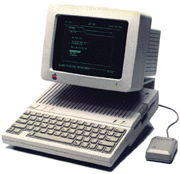 A brief change in topics from my usual rants about SOA. Those of you who have met me know I’m an Apple fan. The first computer I ever bought with my own money was an Apple //c, and I’ve been an Apple owner ever since. I’ve never had the latest and greatest Mac, however, I was an owner of a first generation iPod. Along the way, I upgraded to a third generation, added a shuffle, and recently went up to a black video iPod.
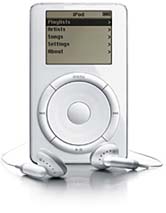
Anyway, as we all know, there’s no shortage of accessories for the iPod, including speakers, cases, voice recorders, bluetooth adapters and headphones, and FM transmitters. I’ve got my fair share of these. But, as I glanced through September issue of MacAddict Magazine, I’ve determined that the craze has gone too far. Yes, some people may have thought we’d reach that point when entire vehicles were being sold as accessories for the iPod. I was okay with that though, since people do listen to a lot of music in their cars. So what iPod accessory could it be that has made me say things have gone too far? It is the iCarta: Stereo dock for iPod with Bath Tissue Holder.

Buy yours now, $149.95 at Atech Flash Technology. Of course, a friend told me about a scene on the show Eureka where a character walks into a room that is supposed to be a bathroom but is empty. Then, the toilet, tub, etc. all slide out from panels in the room, including a screen over the toilet that can display any newspaper in the world. The character remarks that he’ll never have to come out again. I guess if he had an iCarta and a healthy supply of podcasts from IT Conversations, he may not have to come out…
ITIL and SOA
Something I’ve blogged about in the past is vertical SOAs, even wondering the role they’ll have in the consulting world. Today, I listened to a podcast from Dana Gardner on IT Shared Services with two reps from HP. I’ve only learned a little bit about ITIL, but this podcast has me wondering whether ITIL is the vertical SOA for running IT. So, two questions out there for my friends in the blogosphere, especially other enterprise architects that have an interest in management technologies and SOA for IT.
- Are you adopting ITIL in your organization?
- If so, have you been able to use the ITIL processes to apply SOA to the business of IT?
I plan on getting up to speed on ITIL and seeing if it makes a suitable example for showing a real-world example of how to go from documented business process to SOA. I’ve always felt that SOA for IT would be a great place for an organization to start. After all, we IT professionals should understand the business of IT. Unfortunately, excellent support for management of systems is not something the vendors get around to providing until version 10. I challenge the vendors listening to come to the market on day one with secured Web Services for management functions, allowing the IT organization to utilize business process and workflow technology to increase the efficiency of the IT organization.
Technorati tags: soa itil shared services itsm
Service-Oriented Consulting
Congratulations and best of luck to Brenda Michelson. She recently left her position with Patricia Seybold Group and introduced Elemental Links, Inc. To quote her blog:
Elemental Links is an IT consulting and advisory practice specializing in strategy, architecture, and portfolio planning for business-driven IT.
Brenda’s announcement got me thinking about the role of consulting in SOA adoption. For the record, I am not a consultant nor have I ever been a consultant, at least in the formal paid sense. I fall into the category of practicing Enterprise Architect like James McGovern and Mike Herrick. I would be an end-user of consulting practices. While I have many friends that are practicing analysts and/or consultants in this space, including Brenda, Jeff Schneider, and the ZapThinkers, Jason and Ron, they all tend to come out of the IT consultancy/advisory space. While there certainly is a market for this, and will be for some time, what is the right way to grow a business in this space?
The answer to this will largely depend on your view on whether SOA is an IT-driven thing or business-driven thing. We all know that a goal of SOA adoption is to render this a moot point. After all, IT is part of the business, isn’t it? While IT-Business alignment will continue to garner significant press for years to come, most would agree that SOA adoption should be about the business and not about the technology. Presuming things head this direction, what does this mean for SOA Consulting companies? Will they be competing for business with companies that provide assistance in adopting Six Sigma and other business re-engineering and improvement efforts? To what extent will these consultancies need to become specialists in different verticals, such as manufacturing, health care, financial services, retail, etc. in order to be successful? Will the marketplace shift to groups that have a more business-centric focus on technology, such as companies like Patricia Seybold Group and Elemental Links? Will SOA become more associated with business discussions than with technical discussions, or will some other term be used?
In my mind, the bigger problem is on the business side. There are lots and lots of consulting companies that exist that can author services in any desired flavor and platform. The real problem is in identifying what the right services are. There are plenty of case studies that have leveraged services for technical benefits, such as in a B2B integration scenario, but where are the case studies that are about SOA and BPM efforts leading to business change and innovation? Who are the consultancies that will make this happen? What will they look like 5 years from now?
I’d love to hear the thoughts of Brenda, Jeff, Patricia Seybold, and any others on this, in as much as they’re willing to share, since it certainly involves their business strategy. I’d also like to hear what other enterprise practitioners like James, Mike, Scott, Mark, and others have to say.
Technorati tags: soa bpm consulting six-sigma
Vertical Service Architectures
We’re beginning to see some movement around vertical service architectures, or better put, the creation of reference service architectures for particular business domains. For example, back in April, HP had a press release announcing “Industry-specific Service-oriented Architectures.” Last week, on August 3rd, IBM announced the acquisition of Webify. Rich Seeley of SearchWebServices.com stated that Robert LeBlanc, general manager of IBM WebSphere Software, characterized a vertical focus as the next generation of SOA.
I remember back about 7 years ago when I was introduced to TogetherJ. A colleague had Peter Coad’s book, Java Modeling in Color with UML. Coad’s gave example models across a wide variety of business areas. While modeling the internals of the systems may not be as useful, as this is likely to vary widely by enterprises. What may not vary as much, are the services that expose the functions of the major components of the enterprise. This is where this new wave of vertical service architectures may have some legs. Companies will be free to implement the services however they want, but the identification of what services, at least some good subset to get started, are needed can be provided in the form of reference architectures. I’m not an industry analyst, so I don’t have the luxury of having seen many enterprises, but my gut tells me that if you compare two retail organizations or two health care organizations, the core services they require are going to be very similar. Differentiation can be made by the implementation of these services, the management of them, and the remaining 20% of services that aren’t typical of all organizations in that vertical.
This starts to imply that there is a range of commodity services that could have wide applicability and are likely not business differentiators, at least not in the sense that you have them. It’s more about how you use them. To that end, it would be great to see community efforts that address some of these domains. I’ve previously blogged about SOA for education. How many elementary, middle, or high schools do you know that have enterprise architects? How many of them even have any dedicated IT staff at all? Often times, it may be the computer instruction who is also acting as architect and operations support. My daughter’s school has a volunteer technology advisory board made up of parents with IT backgrounds that try to assist in the school’s technology efforts. I’ve logged many hours helping them with varied tasks like web site support and the installation of their WeatherBug station. Largely, however, all of the efforts are handled by Mrs. Lewis, who also happens to be teaching all of the kids about computers all day long. It would be great if we technologists, whether analysts, developers, architects, support, etc., could use of skills to help out in the community on these technology related items of our own good will.
Speaking of good will, James McGovern, is one enterprise architect who has posted a few times on giving back to the community, whether through his efforts to teach programming to high schoolers, or now to raise money for the Juvenile Diabetes Research Foundation. I applaud James for his efforts and encourage others to do the same. While it may not be development of vertical SOAs for medical research foundations, it’s still the right thing. I will make sure that the Juvenile Diabetes Research Foundation is on my charitable donation list for this year.
Technorati Tags: SOA, JamesMcGovern