Archive for February, 2008
 Beaming into Social Networks
I’m listening to Jon Udell’s latest innovator conversation, this time with Valdis Krebs, courtesy of IT Conversations. Valdis is a researcher in the area of social networks and he and Jon are discussing sites like Facebook, LinkedIn, Plaxo, MySpace, etc. One of the interesting points that Valdis makes is that social networking has always been a peer-to-peer process. Two people engage in some form of personal, direct communication to form a “connection.” This is predominant form of building a network, rather than joining a club. The model of virtually all the social networking sites is one of “joining”.
The discussion brought me back to the late 90’s when I had purchased a PalmPilot. I actually owned one that had the U.S. Robotics logo on it versus the 3Com or Palm logos that came later. One of the features that came along later (I think it was when I upgraded to a Handspring device) was the ability to “beam” contact information to other Palm owners. The goal was to do away with business cards and instead “beam” information electronically. While I thought the technology was pretty cool, it didn’t survive because the PDA didn’t survive. It all got morphed into mobile device technology, and with the multitude of devices out there now, the ability to quickly share information between two devices disappeared.
I think this would be a great technology to bring back. I attended a conference back in December, and of course walked away with a number of business cards. I then had to take the time to put those contacts into my address book. Thankfully, as an iPhone owner, I only had to put them in one place for my personal devices, but I also had to enter them into my contacts on my work PC. Then became the step of adding all of these people to my networks on LinkedIn (at a minimum). I actually didn’t do this, most of the people actually had already sent me requests for the various social networks.
In thinking about this, I have to admit that this was way too difficult. What we need is the ability to share contact information electronically with our handheld devices via some short range networking technology like Bluetooth, and have that electronic information be “social network aware” so that as a result of the exchange, contacts are automatically added to friends/contact lists on all social networks that the two parties in common. It should be an automatic add, rather than a trigger of email to each party of “do you want to add this person to your network?” An option would be to ask that question on the device at the time of the interchange, which would allow people to be added to appropriate networks as is supported by sites like Plaxo Pulse.
So, for all of you involved with social networking technology, here’s your idea to go run with and make it happen. I’ll be a happy consumer when it becomes a reality.
IT Conversations: OpenDNS
I listened to the latest Technometria podcast from IT Conversations yesterday, which was a conversation with David Ulevitch, CEO of OpenDNS. It was a great discussion about some of the things they’re trying to do to take DNS into the future. It certainly opened my eyes up to some things that can be done with a technology that every single one of us uses every day but probably takes for granted. Give it a listen.
Service Lifecycle Management
I attended a presentation from Raul Camacho from the SOA Solutions group of Microsoft Consulting Services yesterday. The talk provided some good details on some of the technical challenges associated with lifecycle events associated with services, such as the inevitable changes to the interface, adding new consumers, etc., but I actually thought it was pretty weak on the topic. I thought for sure that I had a blog post on the subject, but I was surprised to find that I didn’t. Some time ago (January of 2007, to be specific) I indicated that I would have a dedicated post, but the only thing I found was my post on product centered development versus project-centered development. While that post has many of the same elements, I thought I’d put together a more focused post.
The first point, and a very important point, is that the service lifecycle is not a project lifecycle or just the SDLC for a service. It is a continuous process that begins when a service is identified and ends when the last version of a service is decommissioned from production. In between, you’ll have many SDLC efforts associated with each version of the service. I presented this in my previous post like this.
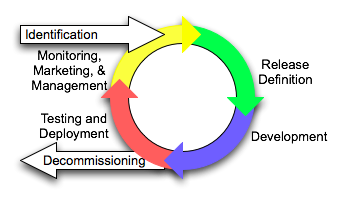
Raul’s talk gave a very similar view, again presenting the lifecycle as a circle with an on-ramp of service identification. The activities he mentioned in his talk were:
- Service Identification
- Service Development
- Service Provisioning
- Service Consumption
- Service Management
There’s many similarities between these two. We both had the same on-ramp. I broke out the SDLC into a bit more detail with steps of release definition, development, testing, and deployment, while Raul bundled these into two steps of development and provisioning. We both had management steps, although mine labeled it as the triple-M of monitoring, marketing, and management. The one key difference was Raul’s inclusion of a step of service consumption. I didn’t include this in my lifecycle, since, in my opinion, service consumption is associated with the lifecycle of the consumer, not with the lifecycle of the service. That being said, service consumption can not be ignored, and is often the event that will trigger a new release of the service, so I can understand why one may want to include it in the picture.
The thing that Raul did not mention in his talk, which I feel is an important aspect, is the role of the Service Manager. We don’t need Service Lifecycle Management if there isn’t a Service Manager to manage it. Things fall apart when there isn’t clear lines of responsibility for all things about a service. For example, a frequent occurrence is where the first version of a service is built by a team that is responsible for both the initial consumer and the service. If service ownership and management falls to this team, it is at best a secondary interest, because their real focus was on the delivery of the service consumer, not of the service itself. A second approach that many organizations may take is to create a centralized service team. While this ensures that the ownership question will get resolved, it has scalability problems because centralized teams are usually created based upon technical expertise. Service ownership and management has more to do with the business capability being provided by the service than it does with the underlying technologies used to implement it. So, once again, there are risks that a centralized group will lack the business domain knowledge required for effective management. My recommendation is to align service management along functional domains. A service manager will likely manage multiple services, simply because there will be services that change frequently and some that change infrequently, so having one manager per service won’t make for an even distribution of work. The one thing to avoid, however, is to have the same person managing both the service and the consumer of a service. Even where there is very high confidence that a service will only have one consumer for the foreseeable future, I think it’s preferable to set the standard of separation of consumer from provider.
So, beyond managing the releases of each service, what does a service manager do? Well, again, it comes back to the three M’s: Monitor, Market, and Manage. Monitoring is about keeping an eye on how the service is behaving and being used by consumers. It has to be a daily practice, not one that only happens when a red light goes off indicating a problem. Marketing is about seeking out new consumers of the service. Whether it’s for internal or external use, marketing is a critical factor in achieving reuse of the service. If no one knows about it, it’s unlikely to be reused. Finally, the manage component is all about the consumer-provider relationship. It will involve bringing on new consumers found through marketing and communication which may result in a new version, provisioning of additional capacity, or minimally the configuration of the infrastructure to enforce the policies of the service contract. It will also involve discussions with existing consumers based on the trends observed through the monitoring activity. What’s bad is when there is no management. I always like to ask people to think about using an external service provider. Even in cases where the service is a commodity with very predictable performance, such as getting electricity into your house, there still needs to be some communication to keep the relationship healthy.
I hope this gives you an idea of my take on service lifecycle management. If there’s more that you’d like to hear, don’t hesitate to leave me a comment or send me an email.
Perception Management
James McGovern frequently uses the term “perception management” in his blog, and there’s no doubt that it’s a function that most enterprise architects have to do. It’s an incredibly difficult task, however. Everyone is going to bring some amount of vested interests to the table, and when there’s conflict in those interests, that can create a challenge.
A recent effort I was involved in required me to facilitate a discussion around several options. I was putting together some background material for the discussion, and started grouping points into pros and cons. I quickly realized, however, that by doing so, I was potentially making subjective judgements on those points. What I may have considered a positive point, someone else may have considered it a negative point. If there isn’t agreement on what’s good and what’s bad, you’re going to have a hard time. In the end, I left things as pros and cons, since I had a high degree of confidence that the people involved had this shared understanding, but I made a mental note to be cautious about using this approach when the vested interests of the participants are an unknown.
This whole space of perception management is very interesting to me. More often than not, the people with strong, unwavering opinions tend to attract more attention. Just look at the political process. It’s very difficult for a moderate to gain a lot of attention, while someone who is far to the left or far to the right can easily attract it. At the same time, when the elections are over, the candidates typically have to move back toward the middle to get anything done. Candidates who are in the middle get accused of flip-flopping. Now, put this in the context of a discussion facilitator. The best facilitator is probably one who has no interests of his or her own, but who is able to see the interests of all involved, pointing out areas of commonality and contention. In other words, they’re the flip-floppers.
I like acting as a facilitator, because I feel like I’ve had a knack for putting myself in someone else’s shoes. I think it’s evident in the fact that you don’t see me putting too many bold, controversial statements up on this blog, but rather talking about the interesting challenges that exist in getting things done. At the same time, I really like participating in the discussions because it drives me nuts when people won’t take a position and just muddle along with indecision. It’s hard to participate and facilitate at the same time.
My parting words on the subject come from my Dad. Back in those fun, formative high school years as I struggled through all of the social dynamics of that age group, my Dad told me, “you can’t control what other people will do or think, you can only control your own thoughts or actions.” Now, while some may read this and think that this means you’re free to be an arrogant jerk and not give a hoot what anyone thinks about you, I took it a different way. First and foremost, you do have to be confident in your own thoughts and beliefs. This is important, because if you don’t have certain ideals and values on who you want to be, then you’re at risk for being someone that will sacrifice anything just to gain what it is you desire, and that’s not necessarily a good thing. Second, the only way to change people’s perception of you is by changing your own actions, not by doing the same thing the same way, and hoping they see the light. I can’t expect everyone to read the topics in this blog and suddenly change their IT departments. Some may read it and not get it at all. Some may. For those that don’t, I may need to pursue other options for demonstrating the principles and thus change their perceptions. At the same time, there will always be those who are set in their ways because they have a fundamental different set of values. Until they choose to change those values, your energy is best spent elsewhere.
Multi-tier Agreements from Nick Malik
Nick Malik posted a great followup comment to my last post on service contracts. For all of you who just follow my blog via the RSS feed, I thought I’d repost the comment here.
The fascinating thing about service contract standardization, a point that you hit on at the end of your post, is that it is not substantially different from the standardization of terms and conditions that occurs for legal agreements or sales agreements in an organization.
I am a SOA architect and a member of my Enterprise Architecture team, as you are, but I’m also intimately familiar with solutions that perform Contract Generation from Templates in the Legal and Sales agreements for a company. My employer sells over 80% of their products through the use of signed agreements. When you run $3B of revenue, per month, through agreements, standardization is not just useful. It is essential.
When you sign an agreement, you may sign more than one. They are called “multi-tier� agreements, in that an agreement requires that a prior one is signed, in a chain. There are also “associated agreements� that are brought together to form an “agreement package�. When you last bought a car, and you walked out with 10 different signed documents, you experienced the agreement package firsthand.
These two concepts can be leveraged for SOA governance in terms of agreements existing in a multi-tier environment, as well as services existing in an ecosystem of agreements that are part of an associated package.
For example, you could have one of four different supporting agreements that the deployment team must agree to as part of the package. All four could rely on the same “common terms and taxonomy� agreement that every development and deployment team signs (authored by Enterprise Architecture, of course). And you could have a pair of agreements that influence the service itself: one agreement that all consumers must sign that governs the behavioural aspects of the service for all consumers, and another agreement that can be customized that governs the information, load, and SLA issues for each provider-consumer pair.
If this kind of work is built using an automated agreement management system, then the metadata for an agreement package can easily be extracted and consumed by automated governance monitoring systems. We certainly feed our internal ERP system with metadata from our sales agreements.
Something to think about…
The Elusive Service Contract
In an email exchange with David Linthicum and Jason Bloomberg of ZapThink in response to Dave’s last podcast (big thanks to Dave for the shout-out and the nice comments about me in the episode), I made some references to the role of the service contract and decided that it was a great topic for a blog entry.
In the context of SOA Governance, my opinion is that the service contract is the “container” of policy that governs behavior at both design-time and run-time. According to Merriam-Webster, a contract is “a binding agreement between two or more persons or parties; especially : one legally enforceable.” Another definition from Merriam-Webster is “an order or arrangement for a hired assassin to kill someone” which could certainly have implications on SOA efforts, but I’m going to use the first definition. The key part of the definition is “two or more persons or parties.” In the SOA world, this means that in order to have a service contract, I need both a service consumer and a service provider. Unfortunately, the conversations around “contract-first development” that were dominant in the early days caused people to focus on one party, the service provider, when discussing contracts. If we get back to the notion of a contract as a binding agreement between two parties, and going a step further by saying that the agreement is specified through policies, the relationship between the service contract and design and run time governance should become much clearer.
First, while I picked on “contract-first development” earlier, the functional interface is absolutely part of the contract. Rather than be an agreement between designers and developers, however, it’s an agreement on between a consumer and a provider on the structure of the messages. If I am a service provider and I have two consumers of the service, it’s entirely possible that I expose slightly different functional interfaces to those consumers. I may choose to hide certain operations or pieces of information from one consumer (which may certainly be the case where one consumer is internal and another consumer is external). These may have an impact at design-time, because there is a handoff from the functional interface policies in the service contract to the specifications given to a development team or an integration team. Beyond this, however, there are non-functional policies that must be in the contract. How will the service be secured? What’s the load that the consumer will place on the service? What’s the expected response time from the provider? What are the notification policies in the event of a service failure? What are the implications when a consumer exceeds its expected load? Clearly, many of these policies will be enforced through run-time infrastructure. Some policies aren’t enforced on each request, but have implications on what goes on in a request, such as usage reporting policies. My service contract should state what reports will be provided to a particular consumer. This now implies that the run-time infrastructure must be able to collect metrics on service usage, by consumer. Those policies may ripple into a business process that orchestrates the automated construction and distribution of those usage reports. Hopefully, it’s also clear that a service contract exists between a single consumer and a single provider. While each party may bring a template to the table, much as a lawyer may have a template for a legal document like a will, the specific policies will vary by consumer. One consumer may only send 10,000 requests a day, another consumer may send 10,000 requests an hour. Policies around expected load may then be enforced by your routing infrastructure for traffic prioritization, so that any significant deviation from these expected load don’t starve out the other consumers.
The last comment I’d like to make is that there are definitely policies that exist outside of the service contract that influence design-time and run-time, so don’t think that the service contract is the container of all policies. I ran into this while I was consulting when I was thinking that the service contract could be used as a handoff document between the development team and the deployment team in Operations. What became evident was that policies that govern service deployment in the enterprise were independent of any particular consumer. So, while an ESB or XML appliance may enforce the service contract policies around security, they also take care of load balancing requests across the multiple service endpoints that may exist. Since those endpoints process requests for any consumer, the policies that tell a deployment team how to configure the load balancing infrastructure aren’t tied to any particular service contract. This had now become a situation where the service contract was trying to do too much. In addition to being the policies that govern the consumer-provider relationship, it was also trying to be the container for turnover instructions between development and deployment, and a single document couldn’t do both well.
Where I think we need to get to is where we’ve got some abstractions between these things. We need to separate policy management (the definition and storage of policies) from policy enforcement/utilization. Policy enforcement requires that I group policies for a specific purpose, and some of those policies may be applicable in multiple domains. Getting to this separation of management from enforcement, however, will likely require standardization in how we define policies, and they simply don’t exist. Policies wind up being tightly coupled to the enforcement points, making it difficult to consume them for other purposes. Of course, the organizational culture needed to support this mentality is far behind the technology capabilities, so these efforts will be slow in coming, but as the dependencies increase in our solutions over time, we’ll see more and more progress in this space. To sum it up, my short term guidance is to always think of the service contract in terms of a single consumer and a single provider, and as a collection of policies that govern the interaction. If you start with that approach, you’ll be well positioned as we move forward.
Why is Governance a four-letter word?
Recent articles/blogs from Michael Meehan and Dan Foody both emphasized the typically negative connotations associated with governance. Michael compared governance to getting a colonoscopy with an IMAX camera, while Dan pointed out that “governance is about defining the box that you’re not allowed to think outside.”
I won’t argue that most people have a very negative reaction to the term, but there’s a key point that missing in the discussion. Governance is about the people, policies, and processes put in place to obtain desired behaviors. Governance does not have to be about command and control. If your desired behavior is complete freedom to try anything and everything, clearly, you don’t want rigid command and control structures. If your goal is to be a very innovative company, but your command and control structures prevent you from doing so in a timely fashion, that’s not a problem with governance per se, but with the governance model you’ve chosen. While the United States has clear separation between church and state, the same can’t be said for many other countries in the world. If the desired behavior for those countries is strict adherence to religious principles, then clearly there will be some challenges in applying the United States’ governance model to those countries. It doesn’t mean those countries don’t need governance, it means they need a different style of governance.
One of my earliest posts on the subject of governance emphasized that the most important thing is that your governance model match your corporate culture. If it doesn’t it’s not going to work. I’ll also add to it that your employees need to accept that corporate culture as well. If the people in the company don’t agree with the desired behaviors that the leaders have established, you’re going to have problems. We need to stop attacking governance, and instead educate our staff on the desired behaviors and why they’re important so that people will want to comply. It must be the path of least resistance. That’s still governance, though. It’s just governance done right.
Integration as a Service
A combination of things, including the Workday acquisition of CapeClear and doing my taxes, got me thinking a bit more deeply about integration as a service (IaaS). When I have my large enterprise hat on, I’ll admit that IaaS doesn’t excite me very much. The main reason for this starts with what I envision when I see this, however. What I picture is taking all of the mapping exercises, transformations, etc. that are done today using some visual tool from an EAI vendor and moving it to a web-based system. I still need to do all of the work to wire things up, but the actual processing behind all of this goes on outside the firewall. This certainly doesn’t make sense if all of my integration points exist within the firewall, and I’d even go further to say that it’s not very attractive when only one of the integration points is outside of the firewall. Why? Well, there are already providers out there that will not only handle the processing, but also do the mapping. Essentially, I give them information on how I want my data, and they take care of doing all the dirty work to map to the other integration point. So, from this perspective, my definition of IaaS actually winds up having me do more work than the traditional “integration as a service” providers.
If all of my integration points are outside of the firewall, things get a bit more interesting. This occurred to me when I was doing my taxes. Most of the leading tax software providers have both desktop versions and online versions. In the case of the online version, the data resides in the cloud. The data behind the tax return must integrate with data from other cloud providers, such as payroll systems and financial services companies. While this integration works well, the same situation isn’t as good for general personal financial planning software. Take Quicken for example. In the desktop version, some of my financial data can’t be automatically imported into Quicken, because the financial provider hasn’t exposed the information according to the necessary standards. Interestingly, however, when I looked into the recently announced Quicken Online, some of the financial providers that didn’t work in the desktop version were able to be integrated into the online version. I suspect that there may be some screen scraping going on, as is the case for many financial aggregators like Yahoo Finance.
Anyway, the short point to that long winded paragraph is that when all of the data exists in the cloud, there’s no doubt that the need to integrate that data for one purpose or another will soon follow. The key question then, however, is whether services should be provided to allow individuals to create their own integration paths, or if the service providers will be expected to simply integrate with other leading offerings, much in the same way we expect the software we install inside our firewalls or inside our homes to integrate. I suspect it will be the latter. Whether its the consumer market or the enterprise market, I think we all want the difficult integration problems to be handled for us. The vendors that are able to do so, will be successful.
So much workflow, so little time
If your organization has begun to leverage workflow technologies as built into the typical BPM suite, you’ve probably run into one of the key challenges: when to use the BPM’s workflow engine versus the workflow capabilities of any of the other products you have in your enterprise. There’s no shortage of products that have built in workflow capabilities. Think about it. Most document management products have workflow capabilities (albeit typically associated with document approval). Your portal may have workflow capabilities. Your SDLC tools may include workflow for bug tracking. Your operations group may leverage a ticketing/work management system with workflow capabilities. So what’s the enterprise to do?
One of things that I’ve advised in the past is to consider whether or not the workflow involved requires any customization or not. Take the SDLC tooling as an example. While there’s typically some ability to change some of the data that flows through the process, the workflow itself probably doesn’t vary much from organization to organization. As a different example, imagine the workflow that supports the procurement and installation of new servers. While most organizations probably support this through a service request system, the odds are that the sequencing of tasks will vary widely from organization to organization. So, the need for customization is one factor. Unfortunately, it’s not the only one. You also have to consider the data element. Any workflow is going to have some amount of contextual information that’s carried throughout. So, while there may be a big need for process customization, that may be offset by the contextual information and schemas that may be provided as part of a tailored third party product.
All in all, the decision on when to use a general purpose workflow engine and when to use a tailored product is no different than the decisions an organization makes on when to build solutions in house versus when to buy packaged solutions. Look at the degree of customization you need in the workflow versus the pre-defined processes. Look at the work that will involved in setting up your own custom data stores and schemas versus the pre-defined databases. Ultimately, I think all large organizations will have a mixture of both. Unfortunately, that means some short term pain. All workflow systems typically have task management with them. Multiple tools means multiple task managers. Multiple task managers means multiple places to do your work. This isn’t exactly efficient, but, until we have standard ways to publish tasks to a universal task list and other standards associated with the use of workflow engines, we should strive to make good decisions on a process-by-process basis.
CapeClear and Workday
I saw the announcements yesterday that Workday had acquired CapeClear. This is an interesting acquisition. At first glance, I thought this was just normal evolution in the ERP space, except that Workday just happens to be a hosted solution. After all, Oracle and SAP both have integration products that enable integration with their backend applications, so why not Workday? The part of this that is a bit distressing, however, is that Workday is a new entrant into this space. A big reason that these integration products exist is because every application had its own proprietary integration approach. As the need to integrate became more and more important, the desire to standardize the integration approaches increased, and led to technologies like Web Services. Workday, as a relatively new player in the space, should have been able to go with standardized integration approaches from the start, significantly reducing the need for integration middleware. There will always be a need for something in the middle, but it should start to look more like network devices than complex middleware. If this theory is true, then why would Workday need to acquire an integration middleware company like CapeClear? Perhaps the only reasoning in this is that CapeClear had always tried to be more that just mediation fabric. After all, I had railed on CapeClear in the past when David Clarke said, “We consider ESB the principal container for business logic. This is the next generation application server.” It’s likely that Workday actually used them in this fashion, rather than as a lightweight mediation fabric that I prefer. If that’s the case, then it’s entirely possible that Workday was in a position where it would be too expensive to migrate to a traditional Java application server, and CapeClear was struggling being one of the few SOA startups left with rough economic times ahead. The best course for both parties, therefore, is the actions that have taken place. It will remain to be seen how well Workday can support the existing CapeClear customers who are using it as a mediation fabric, since their bread and butter is the ERP system, not middleware.
Why do we make things so difficult?
I’ve recently been trying to help out with an issue which has required me to roll up my sleeves a bit, and unfortunately it has brought pack all too familiar memories. Our computer systems (and often the documentation that goes along with it) simply makes things way too difficult. In my opinion, the thing that I’m trying to do should be a relatively straightforward function, but as I’ve dug into it, I just seem to run into an endless set of configuration parameters that need to be specified. Now, while I’m pretty far removed from my days as a developer, I still consider myself tech savvy and a very quick learner. I can’t help but think what the average joe must go through to try to make these things work. It’s almost as if these systems were written to ensure a marketplace for systems integrators and other consultants.
This all comes back to usability and human-computer interaction, areas that have always been a passion of mine. If your products aren’t usable, it’s simply going to create frustration and distrust. If your documentation or support channels are equally poor, the situation will continue to go down. What’s even worse is when there isn’t a workaround, and the only option left to a user is to find an expert who can help. As a user, I don’t like to be painted into a corner where I have no options. We need to keep these things in mind when we build our own systems for our business partners. If we design systems that aren’t usable and require that the business come find someone in IT every time they try to do certain options, that’s a recipe for disaster. If you don’t have a usability team in your organization, I strongly urge you to find some experts and start building one.
Tools Support Governance, Not Define It
I was surprised at David Linthicum’s latest blog entry. Normally, he’s pretty good about emphasizing that you can’t buy an SOA, but in his “Defining SOA Governance” post, a lot of the conversation was very tool-centric. He stated the following.
Key components of design time SOA governance include:
- A registry and/or repository for the tracking of service design, management, policy, security, and testing artifacts.
- Design tools, including service modeling, dependency tracking, policy creation and management, and other tools that assist in the design of services.
- Deployment tools, including service deployment, typically through binding with external development environments.
- Links to testing tools and services, providing the developer/designer the ability to create a test plan and testing scenarios, and then leverage service testing technology.
On the runtime governance side of things, he did preface the tool capability discussion with this statement: “Thus, runtime governance is the process of enforcing and implementing those policies at service run time.”
I’ve said it before, and I’ll say it again. Governance is about people, policies, and process. Tooling really only comes into play when you start looking at the process portion of the equation. I don’t want to dismiss tooling, because it absolutely is an important part of the governance equation, but if you don’t have the people or the policies, tools won’t help.
The other thing that I want to call out is how “SOA Management” has morphed into “Runtime SOA Governance.” Back in March of 2006, I was on a panel at the InfoWorld SOA Executive Forum and teased the panelist from AmberPoint about hijacking the term, but I’ve relented a bit simply because these terms all have preconceived notions about them, and the use of the term governance probably gets people thinking in the right direction. For many people, SOA Management may imply the kind of passive monitoring that people associated with traditional systems management (not that it should be passive, but that’s the perception many have). Runtime SOA Governance, however, is rooted in the notion of the active enforcement of policies associated with the consumer-provider interaction. If a change in marketing terms helps people understand it, I’m all for it.
But back to the main subject… whether it’s runtime or design time, there’s still a need to understand the policies and people/parties involved. If you don’t understand the concepts associated with a service contract (and it’s not just the functional interface) and have people on the both sides of the interaction who care about them, governance tools aren’t going to do you any good. If you don’t have people defining the enterprise policies associated with choosing and defining services, again, the tools aren’t going to be used effectively.
Don’t vote? Don’t complain.
On my way home from work today, the news on the radio was talking about how the precincts in my area were seeing a voter turnout of 30-40%, and viewing it as a good thing. I think it is pathetic. There are many countries where individual citizens don’t have the right to vote, and here we can’t even get a simple majority to show up, and that’s only of the people who have taken the time to register. My parents always voted, and I’m proud to do the same, no matter how insignificant a particular ballot might be. My Dad told me, “if you don’t vote, you have no right to complain if you don’t like the way things turned out.” Think of what could happen in the current political races if even half of those non-voters cast their ballot. I exercised my right this morning. While most Super-Duper Tuesday polls will have closed when this gets read, I hope those of you who live in areas that haven’t voted yet do the right thing and cast your ballot.
February Events
Here are the SOA, BPM, and EA events coming up in February. If you want your events to be included, please send me the information at soaevents at biske dot com. I also try to include events that I receive in my normal email accounts as a result of all of the marketing lists I’m already on. For the most up to date list as well as the details and registration links, please consult my events page. This is just the beginning of the month summary that I post to keep it fresh in people’s minds.
- 2/4 – 2/6: Gartner BPM Summit
- 2/5: ZapThink Practical SOA: Energy and Utilities
- 2/7 – 2/8: Forrester’s Enterprise Architecture Forum 2008
- 2/11: Web Services on Wall Street
- 2/13 – 2/15: ARIS ProcessWorld
- 2/13: ZapThink Webinar: Leverage Document Centric SOA for Competitive Advantage
- 2/19: Webinar: Integrated SOA Governance
- 2/25 – 2/28: BPTG’s Business Process Transformation – BPM Practitioner Course
- 2/25 – 2/27: Global Excellence Awards in BPM & BPM Technology Showcase
- 2/26 – 2/29: ZapThink LZA Bootcamp