Archive for August, 2008
 Say what? Focus on “what” rather than “how”
I just read Joe McKendrick’s post called “Debate rages over SOA’s ‘cloudy’ future.” It continues on the seemingly endless debate these days on WS-* vs. REST, WOA vs. SOA, etc. For the most part, I’ve avoided this discussion but I finally decided to actually make a statement on it. While there is plenty of value in these discussions, I’d argue that their focus has been on how IT implements solutions. What they don’t focus on is what solutions IT builds, which is where I believe there is much more value to be gained. Are there opportunities for incremental gains in using WS-*/REST/etc.? Absolutely. But is there a change in the solutions that we are delivering other than the implementation under the covers? Make the wrong decisions on what gets built (or bought), and it won’t matter what technology was used to build it, because that will be far more of a limiting factor than whether it was built using Java, C#, Python, WS-*, REST, or anything else. It’s disappointing that so much of the discussion on SOA has focused on the “how” rather than on “what.” Unfortunately, as a corporate IT practitioner, we’re frequently only asked to solve the “how,” and not involved with the “what,” so I’m not at all surprised that this is the state we find ourselves in. We need to continue to work to understand the business that our solutions support in order to be able to challenge the “what” and demonstrate the business value that can be provided by redefining “what,” eventually leading to sitting at the table as part of the team that decides “what.”
More on ITIL and SOA
In his “links” post, James McGovern was nice enough to call additional attention to my recent ITIL and SOA post, but as usual, James challenged me to add additional value. Here’s what he had to say:
Todd Biske provides insight into how ITIL can benefit SOA but misses an opportunity to provide even more value. While it is somewhat cliche to talk about continual process improvement, it would be highly valuable to outline what types of feedback do operations types observe that could benefit the software development side of the house.
I thought about this, and it actually came down to one word: measurement. You can’t improve what you’re not measuring. It’s debatable as to whether or not operations does any better than software development in measuring the service they provide, but operations is probably in a better position to do so. Why? There is less ambiguity about the service being provided. For example, a common service from operations in big IT shops is building servers. They can measure how many servers they’ve built, how quickly they’ve been built, and they and how correctly they’ve been built, among other things.
In the case of softwre development, is the service being provided software development, or is the capability provided by the software? I’d argue that most shops are focused on the former. If you measure the “software development” service, you’ll probably measure whether the effort was completed on time and on budget. If, instead, you measure based on the capability provided by the software, it now becomes about the business value being provided by the software, which, in my opinion, is the more important factor. Taking this latter view also positions the organization for future modifications to the solutions. If my focus is solely on time and budget, why wouldn’t I disband the team when the project is done? The team has no vested interest in adding additional value. They may be challenged on some other project to improve their delivery time or budget accuracy, but there’s no connection to business value. Putting it very simply, what good does it do to deliver an application on time and on budget that no one uses?
So, back to the question, what can we learn from the ops side of the world. If ops has drunk the ITIL kool-aid, then they should be measuring their service performance, the goals for it should be reflected in the individual goals of the operations team, and it should be something that allows for improvement over time. If the measurement falls into the “one-time” measurement category, like delivering on-time and on-budget, that should be a dead giveaway that you may be measuring the wrong thing, or not taking a service-based view on your efforts.
ITIL and SOA
I’ve been involved in some discussions recently around the topic of ITIL Service Management. While I’m no ITIL expert, the little bit of information that I’ve gleaned from these discussions has shown me that there are strong parallels between SOA and ITIL Service Management.
There’s the obvious connection that both ITIL Service Management and SOA contain the term “service,” but it goes much deeper than that (otherwise, this wouldn’t be worth posting). There are five major domains associated with ITIL: service strategy, service design, service transition, service operation, and continual service improvement. Here’s a picture that I’ve drawn that tries to represent them:
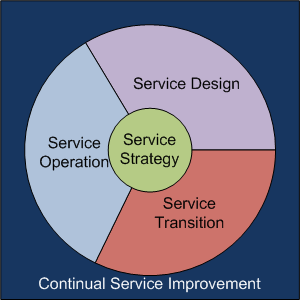
Keeping it very simple, service strategy is all about defining the services. In fact, there’s even a process within that domain called “Service Portfolio Management.” Service Design, Service Transition, and Service Operation are analogous to the tradition software development lifecycle (SDLC): service design is where the service gets defined, service transition is where the service is implemented, and service operation is where the service gets used. Continual Service Improvement is about watching all aspects of each of these domains and striving to improve it.
Now back to SOA side of the equation. I’ve previously posted on the change to the development process that is possible with SOA, most recently, this one. The essence of it is that SOA can shift the thinking from a traditional linear lifecycle that ends when a project goes live to a circular lifecycle that begins with identification of the service and ends with the decommissioning of the service. Instead, the lifecycle looks like this:
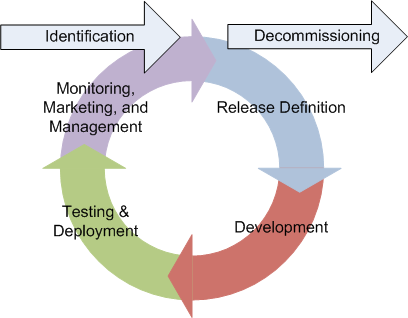
The steps of release definition, development, testing, and deployment are the normal SDLC activities, but added to this is what I call the triple-M activity: monitoring, marketing, and management. We need to do the normal “keep the lights on” activities associated with monitoring, but we also need to market the service and ensure its continued use over time, as well as manage its current use and ensure that it is delivering the intended business value. If improvements can be made through either improvements in delivery or by delivering additional functionality, the cycle begins again. This is analogous to the ITIL Service Management Continual Service Improvement processes. While not shown, clearly there is some strategic process that guides the identification and decommissioning activities associated with services, such as application portfolio management. Given this, these two processes have striking similarities.
What’s the point?
The message that I want you to take away is that we should be thinking about application and “web” service delivery in the same way that we are thinking about ITIL service delivery. Many people think ITIL is only about IT operations and the infrastructure, but that’s not the case. If you’re a developer, it equally applies to the applications that you are building and delivering. Think of them in terms of services and the business value that they deliver. When the project for version 1 ends, don’t stop thinking about it. Put in place appropriate metrics and reporting to ensure that it is delivering the intended value and watch it on a regular basis. Understand who your “users” are (it could be other systems and the people repsonsible for them), make sure they’re happy, and seek out new ones. Adopt a culture of continuous improvement, rather than simply focus on meeting the schedule and the budget and then waiting for the next project assignment.
Governance: Are you on the left or the right?
Dan Foody of Progress Software posted a followup to my last post entitled, “Less Governance is Good Governance.” Clearly, when it comes to SOA governance, Dan falls on the right. For those of you not in the US, the right, when used in the political sense, refers to the Republican party. The Republican party is typically the champion of less government. On the opposite side of the political fence, over on the left, are the Democrats. The Democratic party is typically associated with big government and more regulation. This post isn’t about US politics, however, it’s about SOA governance.
In line with his right-facing view, Dan’s final statement in his post says, “As much governance as is absolutely necessary, but no more.” Well, the United States has had successful times when Congress at times when each party had the majority, likewise for the presidency. So, I don’t think that it’s a uniform truth that less governance is good governance. Good governance is not defined by how quickly your team comes to consensus, it’s defined on whether or not you achieve your desired behavior. Sometimes, that may only require a few policies. Other times, it may require lots of policies, and lots of regulation. It is completely dependent on the current behavior of your organization, the behavior you need to have to be successful, and the degree to which everyone in the organization understands it and agrees with it, which is why communication is so important. Left? Right? Both can be successful, it’s all about where you are and where you need to go.
Governance does not imply Command and Control
In a recent discussion I had on SOA Governance with Brenda Michelson, program director for the SOA Consortium, she passed along a link to this article from Business Week. It’s the story of Tom Coughlin, coach of the Super Bowl champion New York Giants, and how he had to change from his reputation of an “autocratic tyrant” in order for the team to ultimately succeed.
What does this have to do with governance? When you think of governance, what comes to mind? My suspicion is that for most people, it’s not a positive image. At its extreme worst, I’ve heard many people describe governance as a slow, painful process that requires investing significant time preparing for a review by people who are out of touch with what a project is trying to do that ultimately results in the reviewers flaunting authority, the project team taking their lumps, and then everybody goes back to doing what they were doing with no real change in behavior other than increased animosity in the organization. In other words, exactly the situation that Tom Coughlin had with previous teams.
The fact is that governance is a required activity of any organization. Governance is the way in which an organization leverages people, policies, and processes to achieve a desired behavior. In the case of the New York Giants, their desired behavior was winning the Super Bowl. In years past, only people involved with setting the policies was the coaching staff, and the processes consisted of yelling and screaming. It didn’t work. When the desired behavior wasn’t achieved, change was needed, and that change was made in the governance. Players became involved in setting policies through a leadership council. That same council also became part of the governance process in both educating other players about the policies as well as ensuring compliance.
Unfortunately, when governance gets discussed, people naturally assume a command and control structure. When an individual sees a new statement “Thou shall do this” or “Thou shall not do that,” they think command and control, especially if they weren’t involved with the setting of the policy. As we grow, this sentiment becomes increasingly important. How many of us that live in large countries feel our politicians are disconnected from us, even if they are elected representatives? Those policies still need to be set, however, and there will always be a need for some form of authority to establish the policies. The key is how the “authority” is established and how they then communicate with the rest of the organization. If the authority is established by edict, and only consists of one-way communication (down) from the authority, guess what? You have a dictatorship with a command-and-control structure. If you set up representative groups, whether formal or informal, and focus on bi-directional communication, you can conquer that command-and-control mentality. The risk with that approach is that the need for “authority” is forgotten. Decisions still must be made and policies must be set, and if the group-think can’t do that, there will still be problems. Morale may not impacted in the same negative way as a command-and-control approach, but the end result is that you’re still not achieving the desired behavior.
Good governance is necessary for success, and open communication and collaboration is necessary for good governance. My recommendation is that if you are an in a position of authority (a policy setter and/or enforcer), you must keep the lines of communication open with your constituents and help them to set policies, change policies that are doing more harm than good, and understand the reasons behind policies. If you are a constituent, you need to participate in the process. If a policy is causing more harm than good in your opinion, make it known to the authorities. Sometimes that may result in a policy change. Sometimes it may result in you changing your expectations and seeing the reasons why compliance is necessary.
Cloud versus Grid
I am back from vacation and trying to catch up on my podcasts. In an IT Conversations Technometria Podcast, Phil Windley spoke with Rich Polski. Rich is working on Eucalyptus, an open source implementation of the Amazon EC2 interface.
Rich gave a great definition of the difference between grid computing and cloud computing. Grid computing typically involves a small number of users requesting big chunks of resources from a homogenous environment. Cloud computing typically involves a large number of users with relatively low resource requirements from a heterogenous environment.
Rich and Phil went on to discuss the opportunities for academic research in the cloud computing and virtualization spaces. If you are considering when and how to leverage these technologies, give it a listen.